
It’s been about 80 years since Anne Frank died, yet her brief life remains an inspiration to people around the globe. While her assertion that “In spite of everything I still believe that people are really good at heart,” at times rings as nothing but naively innocent, her ability to hold onto to this optimistic perspective provides a beacon of light even during the dark days our country is presently confronting.
I’ve long been an admirer of Anne and her diary deeply impacted me as both a reader and a writer. The universality of her experiences as a girl growing into a woman transcended in many ways the circumstances in which this evolution occurred. The conflict between her isolation from beyond the walls of her hiding place and the closeness of her quarters, embodied for me the desire to both be free and the need for nurturing support.
Reading the diary as an elementary student left me with an incredibly deep sorrow along with a distinct sense of connection. I was German, too. Could Anne’s life (and death) have been mine had I been born 35 years sooner? She was only a decade older than my own mother – could her fate have been that of a member of my own family?
As I learned more about the persecution of Jews, I realized that the Meders of Bubenbach, Germany would not have the same targets that the Frank family, and literally millions of other families, had been because we were Catholic, a religion not in in the crosshairs during the 20th century.
But, then, I began to fret – did my family play a much darker role than I had ever considered during WWII? Were the Meders of my Opa’s generation contributors to genocide?
Needless to say, The Diary of Anne Frank raised a lot of my questions for me. Tuesday’s conversation with author Ruth Franklin about her new book both resolved some of them and dispelled false impressions which I’ve held for decades.
According to Franklin, Anne’s diary was not all an accidentally published personal account of a few brief years in a young girl’s life. In fact, it was a carefully edited presentation rewritten by Anne for public consumption. She wanted people to read her diary and know what she and her family experienced during their time in hiding. Unlike other claims I’ve read, her father, Otto, was not remotely hesitant in sharing her words with the world. He understood the importance of her story, although I don’t believe he ever could have imagined the millions of copies which would be consumed by readers around the world.
The event, organized as a collaboration between the NYSWI, UAlbany’s Writing & Critical Inquiry Program (WCI) and the Jewish Federation of Northeastern New York, was extremely well attended and it was unfortunate that a more appropriately sized venue hadn’t been selected. The Multipurpose Room of the University’s Campus was a bad location for such an important discussion, leaving dozens of people, including elderly folks, to stand or sit on the floor in the overcrowded, overheated room.
It would have been nice to see able bodied students offer their seats to those more senior than themselves.
I’ve got the book on order for my library and am looking forward to reading it and also hope to make it to NYC for the current exhibition at the Center for Jewish History. Although I’ve been fortunate enough to visit the annex in Amsterdam on numerous occasions, the times we’re currently living in make Anne Frank and antisemitism very much a contemporary topic to be examined.
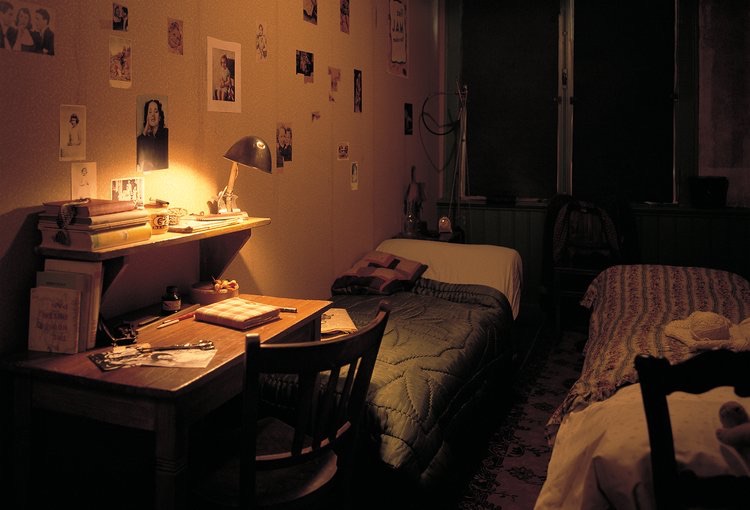
Her message, expressed in the quote below, continues to resonate with its ageless wisdom –
Human greatness does not lie in wealth or power, but in character and goodness.
 DelSo
DelSo 
One thought on “Another peek into the annex – Ruth Franklin’s The Many Lives of Anne Frank”