
The relationship I have with my mother has been problematic for as long as I can remember. While she generally met my most basic needs of shelter, clothing and food, very little beyond that was available or offered to me.
Affection, emotional or financial support, and intimacy were never part of the package.
I’ve worked hard, particularly since becoming a parent myself, to accept the limited mother-daughter connection my mother and I share. The distance between us will never be breached and I’m really ok with that reality.
As I’ve explained to friends, if I wasn’t allowed to rely upon my mother as a young child, there’s no need for me to look to depend upon her as an adult.
Over the years, there have been times of complete estrangement between us. I learned that the best way to prevent her from hurting me was to minimize contact and avoid exposure to the toxicity she seemed to revel in directing towards me.
I say this with zero animosity, it wasn’t hard to not think of her.
A few years ago, however, her circumstances changed. She had a fall that landed her in the hospital 150 miles from her home. Her injuries were compounded by a couple of cases of Covid and a minor stroke all of which combined to give her an extended stay in medical care as she bounced between the hospital and a rehab center. By the time her health was stable enough for discharge months later, her apartment in a senior complex had been vacated and she came back to the area to her new residence in a nursing home.
I felt sorry for her as I imagined the disorientation of leaving one’s home for an event only to return to a new life in a single room in a facility. She was a woman who was very attached to the possessions she collected and now they were mostly gone. Her independence, a state that I also hold dear, was no longer.
I began to visit her, generally every couple of weeks, in her new home. My visits usually lasted an hour or so and I often scheduled them around yoga classes at a nearby studio. I brought her small gifts, things like fresh flowers, favorite foods and skincare items that she needed. At times, I would bring her laundry to my home to wash because of her dissatisfaction with the facility’s care of her clothing.
It was all fine.
In the last six months or so, though, I’ve felt increasingly hesitant to visit her. I plan to go, yet find myself dreading the thought of going to the nursing home and delaying my visit for another day. After reflecting, I concluded that there were a few reasons for my procrastination, none of which are under my control.
My mom never seems to appreciate that I’m there. The television remains on, her hands continue to wield knitting needles and she, generally, doesn’t engage in any meaningful conversation with me. As her dementia becomes increasingly more evident, the confusion she displays about who I am is frustrating – for both of us, I suspect.
And she simply isn’t particularly nice to me.
My last visit to her had been prior to my trip to Wellfleet last month. I had been steeling myself to go to the nursing home for the past week or so and finally, after receiving a text from the one son of mine who has a relationship with her sharing her complaint that she hasn’t seen me since my before my birthday, went yesterday.
I arrived empty handed, but in a positive mood, prepared for our usual superficial interaction. She was her usual mix of cranky and disoriented, complaining about my absence and her need to visit the bank and the store, excursions I’m unwilling to facilitate. She spoke of my brother having visited recently.
In reality, it was my son who had been there.
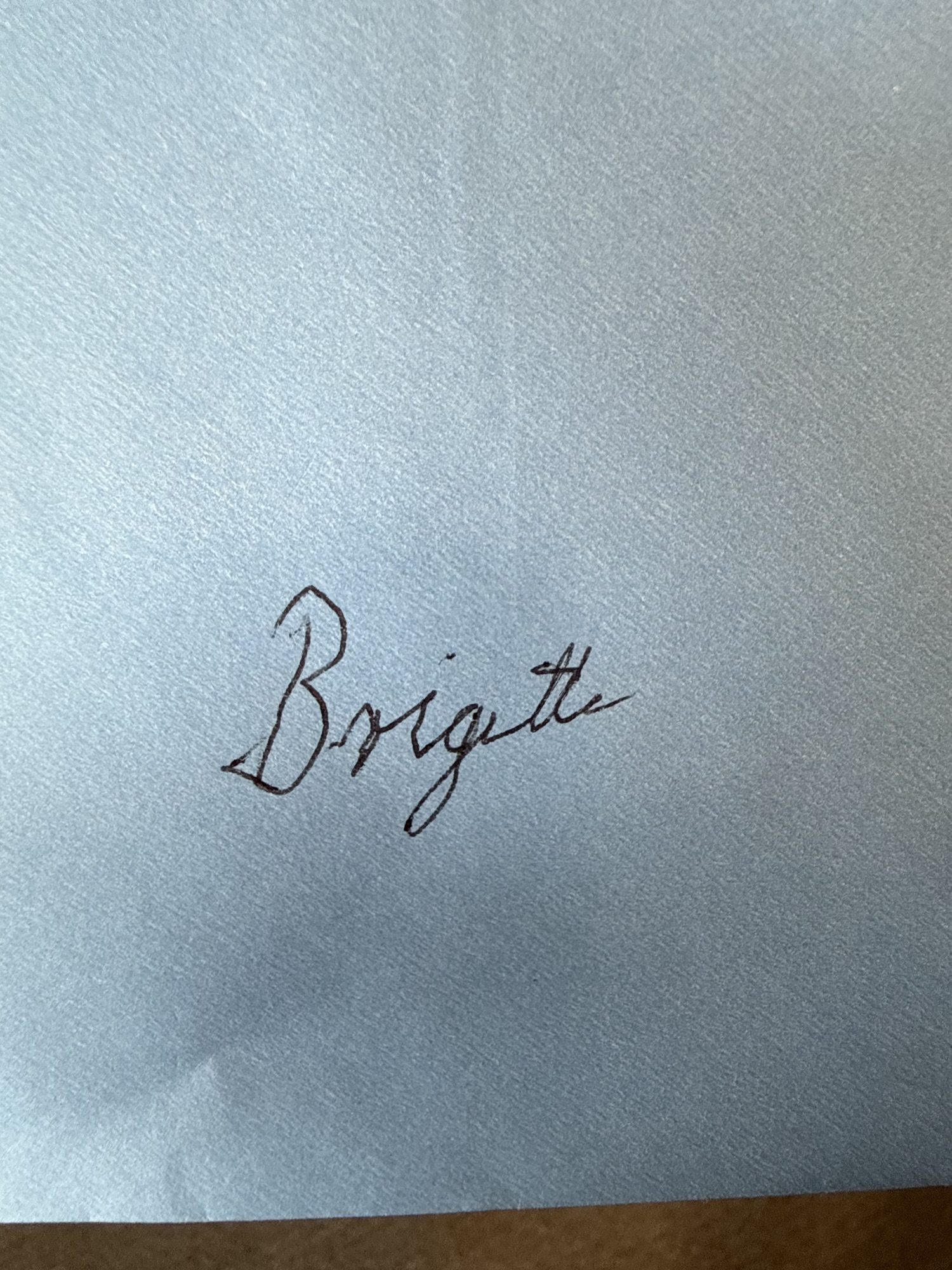
She gestured to a card on the nearby table that she had for me, a belated birthday card. I looked at the envelope with the name “Brigitte” on the front in spidery handwriting. I opened it to read:
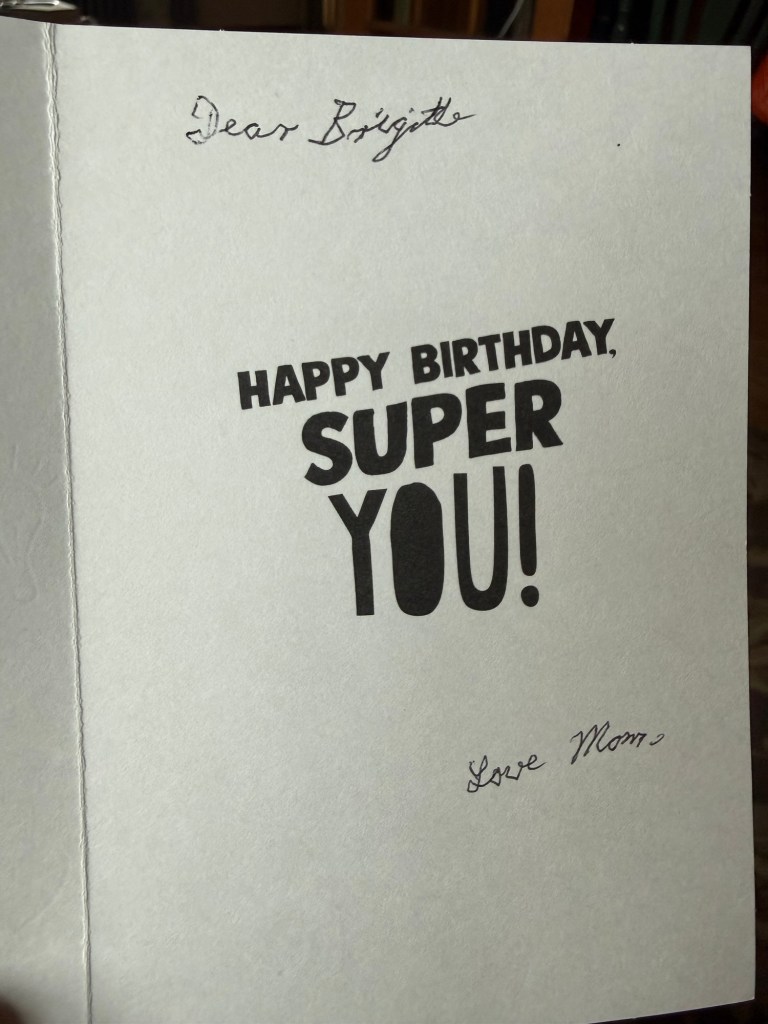
I looked at her and explained that Brigitte was not my name, that I am Silvia. I continued by telling her that Brigitte was her older sister, born second after Elfriede and before her, Hannelore. I reminded her that she had had two additional sisters, as well, Klara and Sister Maria Pia, along with 10 brothers. I took out my phone and showed her some pictures, filed in my Favorites folder, of myself and my brother from when we were young children.
“That’s you?,” she asked. I assured her it was and showed her a couple of additional photos of my Uncle Wolfgang, her youngest brother and my oldest son. She seemed to accept the information without displaying anxiousness or upset.
I left a short time later.
As I sit in my home a day later, I am still feeling an odd sense of confusion. How does my mother have a clear grasp on the frequency of my visits, yet not know my name? She was aware enough of who I was to accuse me of having kept the shirt she was wearing from her, but didn’t recognize me as her daughter.
It’s all so weird…
I never imagined my mother living to the age she is (88) presently, nor did I think she would lose her mind and memories to dementia. Navigating this chapter of life is challenging, but I’m certain that this, too, will eventually come to pass – or my name isn’t Silvia Meder Lilly.

